"Every two years, we have to fight hard to get the money." That's how Congresswoman Julia Brownley described the funding fight behind Channel Islands Harbor's maintenance dredging, the year she delivered a $15 million check to the county to keep the harbor's entrance open. She wasn't talking about home values. She was talking about sand.
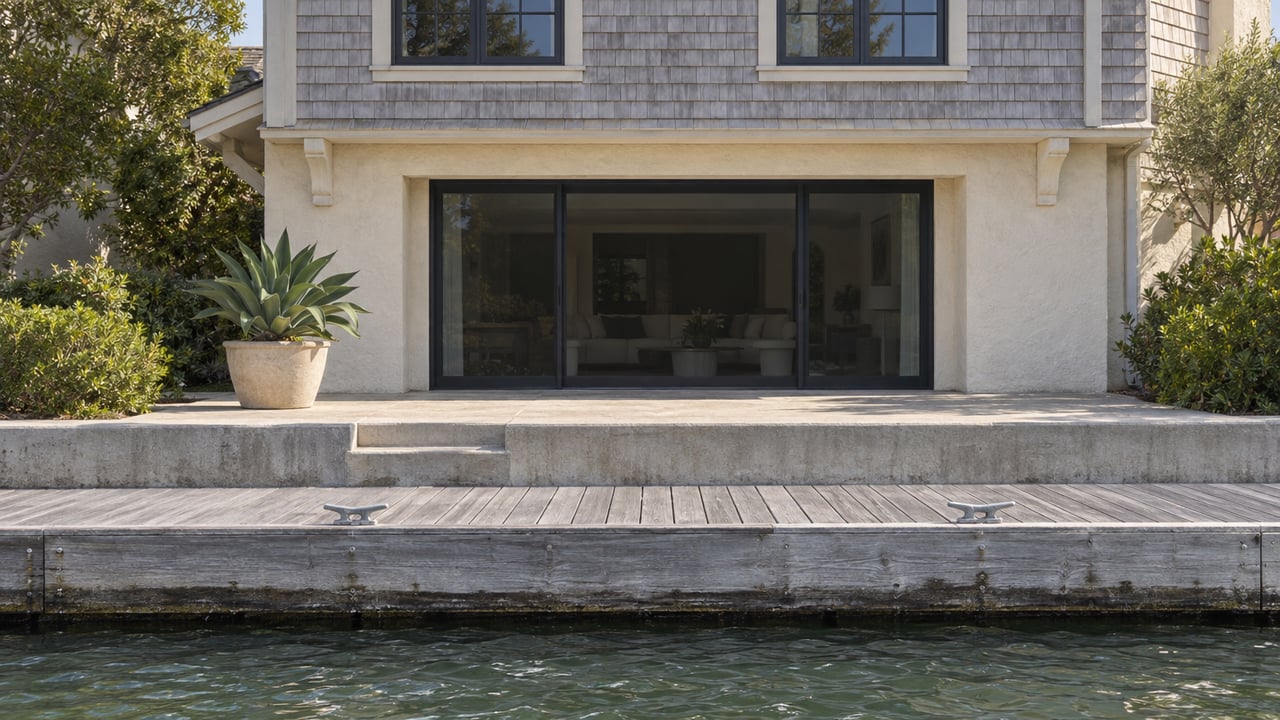
But sand is exactly what stands between a listing's photo of a private dock and what that dock can actually do. For anyone pricing a waterfront home in Channel Islands Harbor, the 40-foot or 45-foot boat slip advertised as a selling point isn't the thing that determines whether a boat can get out to open water. Channel depth does that, and channel depth is maintained on a federal schedule that has already needed a bonus year twice in the last thirteen cycles.
Why the harbor has to be dredged at all
Channel Islands Harbor exists in part as a response to changes along this stretch of coast. When Port Hueneme's jetties went in, they disrupted the natural north-to-south flow of sand, a process called littoral drift. That disruption started eating away at downcoast beaches and threatened Navy installations at Port Hueneme, which today remains the only deep-sea port in California between San Francisco and Los Angeles. The Corps built Channel Islands Harbor in the early 1960s partly as a solution: a sand trap that catches the drifting sand before it falls into a submarine canyon offshore, so the Corps can dredge it back out and place it on the beaches that would otherwise keep eroding.
That's the deal every waterfront property in the harbor is built on top of. The same sand that makes the beaches south of the harbor worth walking on is the sand that, left alone, would eventually choke the harbor entrance closed.
A cycle that keeps needing an extra year
The Corps has dredged the harbor on a roughly two-year rhythm since the 1960s. That rhythm has slipped more than once, and this fall marks the third consecutive year the harbor has needed dredging rather than the usual every-other-year gap.
| Cycle | What happened |
|---|---|
| FY2013 | Federal funding fell short of the full amount needed; the Corps dredged only a fraction of the usual volume, pushing the next cycle back a full year to FY2015 |
| Oct 2022 to Feb 2023 | On-schedule dredge funded by roughly $15 million in federal appropriations |
| Planned 2024 | Permitting, weather, and operational issues kept the Corps from completing the amount of dredging originally planned |
| Jan 2025 | Catch-up dredge to finish the remaining 2024 work; about 1.6 million cubic yards, $16.6 million in funding; the start date itself slipped from Dec. 26, 2024 to Jan. 1, 2025 because of weather |
| Oct 2026 to Feb 2027 | Third consecutive year of dredging; staging begins in October, with the harbor expected to return to its normal two-year rhythm after this cycle wraps |
Line those up and the pattern is plain. The table shows one cycle finished on schedule, one needed a follow-up year to finish the original work, and the current cycle is scheduled to run through February 2027. The dock behind a Channel Islands Harbor home sits downstream of that pattern, not above it.
What an unfinished dredge actually looks like
The harbor's own navigation guidance describes the area southeast of the entrance as subject to rapid and uncertain shoaling, and advises mariners to use caution approaching from the south, especially at night. Boater safety guides go further on the northwest entrance specifically, warning that it can look deep and safe in places when shifting sand underneath is actually shallow enough to ground a hull.
That's not a hypothetical for a boat with real draft sitting on a slip behind a house that was marketed on its water access. Structurally, the dock can be perfect, the pilings sound, the gangway new, and the boat still can't get out at low tide if the channel hasn't been dredged on schedule.
The work itself is not quiet when it happens. Past cycles have run 24 hours a day, seven days a week, for about 90 days at a stretch, and this time heavy equipment on Silver Strand Beach is limited to 7 a.m. to 7 p.m. Ahead of this fall's cycle, the Corps met with residents at Hollywood Beach Elementary School in April to talk through the noise and lighting impacts, building on adjustments made during the last round, when the district reduced engine noise at night and changed lighting angles to cut down on the disruption.
The money is not automatic
Routine maintenance dredging at harbors like this one draws on the Harbor Maintenance Trust Fund, and the administration's FY2027 budget request keeps relying on that fund for ongoing maintenance work rather than cutting it. But trade reporting on that same budget notes that in recent years, several smaller California harbor projects, Channel Islands Harbor among them, have been left out of the administration's initial budget request entirely and restored only after Congress added the funding back during appropriations. The same reporting notes the administration is prioritizing what it calls high-performing projects, a category that smaller recurring maintenance work doesn't always score against as well as major new construction does.
None of that means the money won't show up. It has, every time, for over sixty years. It means showing up has required someone in Washington to go looking for it more than once, and that the harbor's place on next year's list isn't settled the way a property line is.
What this means if you're pricing a dock home
A private boat slip behind a Channel Islands Harbor home is a real feature with a real value premium, and homes with direct water access and private docks command more than comparable homes without them. What buyers evaluating that premium are actually buying, though, is access to a channel maintained by someone else, on a schedule set by someone else, funded by a budget process that doesn't belong to the property.
Three questions are worth asking before writing an offer on one of these homes:
- When was the harbor last fully dredged, and did that cycle finish on the original schedule or need a follow-up year like 2024 did?
- What is the slip depth at low tide, not just the depth advertised at high tide, especially for boats near the 40 to 45-foot easements common around Mandalay Bay and Harbour Island?
- What do the HOA dues actually cover? On most of these properties, dues pay for the dock structure and shared common areas. They don't pay for channel depth. That responsibility sits with the Army Corps and the federal budget process described above, entirely outside the HOA's control.
A boat-access home in Channel Islands Harbor isn't a weaker buy because of any of this. It's a home where one of the features you're paying for is maintained rather than fixed, and buyers who ask about the maintenance schedule are pricing the property the way the harbor actually works, not the way the listing photo makes it look.
If you're comparing waterfront listings in Channel Islands Harbor and want a read on a specific dock's history or a home's real slip depth before you write an offer, Debbie Curran can walk through what's on record for that property and what's coming up on the harbor's dredging calendar next.
This article is general information, not legal, tax or financial advice. Consult a qualified professional about your situation.